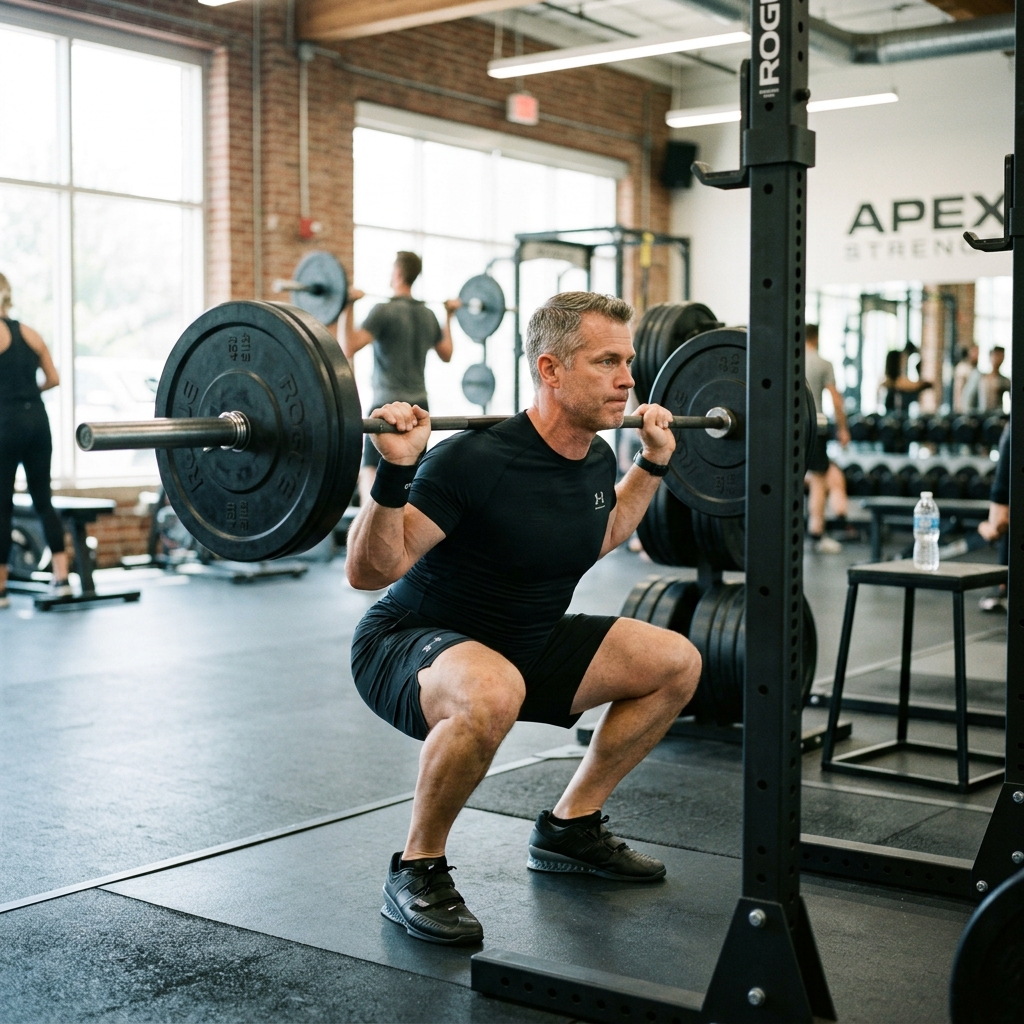
Why 'How Often' Is the Wrong Question After 45
If you're a 45-year-old man looking to get back in shape or maintain the muscle you've built, you've probably asked: "How often should I strength train per week?" It's a fair question, but the real answer isn't a magic number—it's about frequency, intensity, and recovery working together. After 40, your body's ability to recover changes, and training too often can backfire, leading to joint pain, fatigue, and stalled progress.
In this guide, we'll break down the optimal training frequency based on the latest sports science and real-world experience. You'll learn how to structure your week to build muscle, boost testosterone, and protect your joints—without living in the gym.
The Science of Muscle Growth After 40
Muscle protein synthesis (MPS) is the process your body uses to repair and build muscle. After a workout, MPS stays elevated for 24-48 hours, but this response diminishes with age—a phenomenon called anabolic resistance. To overcome this, you need to train each muscle group with enough frequency and volume, but also give it enough time to recover.
Research suggests that training a muscle group twice per week is superior for hypertrophy in older adults compared to once per week. That means a 2-day or 4-day split often works better than a 3-day full-body routine if volume is equalized.
Pro Tip: If you're new to strength training, start with 2 full-body sessions per week. Once you've built a baseline, you can progress to 3 or 4 days by splitting your workouts (e.g., upper/lower).
So, How Many Days Per Week?
For a 45-year-old man, the sweet spot is 2 to 4 days per week of structured strength training. Here’s how to choose:
- 2 days/week: Minimum effective dose. Great for beginners or those with busy schedules. Focus on full-body workouts.
- 3 days/week: The most common and effective for most men. You can do full-body or an upper/lower split with one full-body day.
- 4 days/week: For those who want to maximize muscle growth and have good recovery. Use an upper/lower split.
Training more than 4 days isn't necessary and may increase injury risk without added benefit, especially if you're not eating enough protein or sleeping well.
The 2-Day Full-Body Template (For Beginners or Busy Guys)
If you're just starting or have limited time, this 2-day plan hits every major muscle group with compound lifts.
Workout A (Day 1)
- Squats: 3 sets of 6-8 reps
- Bench Press: 3 sets of 6-8 reps
- Bent-Over Rows: 3 sets of 8-10 reps
- Plank: 3 sets of 30-60 seconds
Workout B (Day 2)
- Deadlifts (or Romanian Deadlifts): 3 sets of 6-8 reps
- Overhead Press: 3 sets of 6-8 reps
- Pull-Ups or Lat Pulldowns: 3 sets of 8-10 reps
- Hanging Leg Raises: 3 sets of 10-15 reps
Schedule: Space them out, e.g., Monday and Thursday.
The 3-Day Full-Body Template (The Sweet Spot)
This is the most balanced approach, allowing adequate recovery while providing enough stimulus.
Day 1 (Heavy Lower Body Focus)
- Squats: 4 sets of 5-6 reps
- Romanian Deadlifts: 3 sets of 8-10 reps
- Standing Calf Raises: 3 sets of 12-15 reps
- Ab Wheel Rollouts: 3 sets of 8-12 reps
Day 2 (Heavy Upper Body Focus)
- Bench Press: 4 sets of 5-6 reps
- Bent-Over Rows: 4 sets of 8 reps
- Overhead Press: 3 sets of 6-8 reps
- Pull-Ups: 3 sets to failure
Day 3 (Hypertrophy / Accessory Day)
- Incline Dumbbell Press: 3 sets of 10-12 reps
- Seated Cable Rows: 3 sets of 10-12 reps
- Lateral Raises: 3 sets of 12-15 reps
- Bicep Curls & Tricep Extensions: 2 sets each
Schedule: Monday, Wednesday, Friday, giving you the weekend off.
The 4-Day Upper/Lower Split (For Advanced Lifters)
If you've been training consistently for over a year and want to push further, this split allows you to hit each muscle group twice per week.
Day 1: Upper Body (Strength)
- Bench Press: 4 sets of 5-6 reps
- Weighted Pull-Ups: 4 sets of 6-8 reps
- Seated Dumbbell Shoulder Press: 3 sets of 8-10 reps
- Barbell Rows: 3 sets of 8 reps
Day 2: Lower Body (Strength)
- Squats: 4 sets of 5-6 reps
- Romanian Deadlifts: 3 sets of 8 reps
- Leg Press: 3 sets of 10 reps
- Calf Raises: 4 sets of 12 reps
Day 3: Upper Body (Hypertrophy)
- Incline Dumbbell Press: 3 sets of 10-12 reps
- Lat Pulldowns: 3 sets of 10-12 reps
- Cable Crossovers: 3 sets of 12 reps
- Face Pulls: 3 sets of 15 reps
Day 4: Lower Body (Hypertrophy)
- Front Squats or Leg Press: 3 sets of 10-12 reps
- Lying Leg Curls: 3 sets of 12 reps
- Walking Lunges: 3 sets of 15 steps
- Seated Calf Raises: 3 sets of 15 reps
Schedule: Monday, Tuesday, Thursday, Friday (Wednesday and weekend rest).
Recovery: The Secret Weapon After 40
Training frequency is only half the equation. After 40, recovery becomes paramount. Here are non-negotiables:
- 1.Sleep: Aim for 7-9 hours. Poor sleep elevates cortisol and reduces testosterone, hampering muscle growth. Learn how to improve sleep quality naturally after 40 with science-based strategies.
- 2.Nutrition: Eat 1.6-2.2 grams of protein per kg of body weight. Don't neglect carbs—they fuel performance and replenish glycogen.
- 3.Stress Management: Chronic stress impairs recovery. Incorporate daily walks, meditation, or deep breathing.
Pro Tip: If you feel unusually fatigued, sore, or notice a drop in performance, take an extra rest day. Overtraining is a real risk after 40.
The Role of Cardio and Active Recovery
Strength training doesn't mean you ignore cardio. In fact, a mix of low-intensity steady-state (LISS) and a couple of high-intensity interval sessions (HIIT) can boost heart health and aid recovery.
- On rest days, do 20-30 minutes of walking or cycling. For longevity insights, check out is walking enough exercise for longevity after 50 revealing the real data.
- On strength days, you can add 10 minutes of HIIT at the end if you have the energy.
Supplements That Support Strength Training Over 40
While diet is the foundation, certain supplements can fill gaps. For example, Vitamin D3 + K2: The Synergistic Duo for Bone Density and Heart Health is critical because vitamin D supports testosterone production and bone density, both vital as you age.
Creatine is another powerhouse. It's not just for bodybuilders—it aids muscle strength and even brain health. Explore Creatine Isn't Just for Bodybuilders: The Brain and Muscle Benefits You’re Missing or dive into the creatine for men over 40 complete guide for dosage and timing.
For a broader look, see the BEST SUPPLEMENTS FOR MEN OVER 40 to support your fitness journey.
Putting It All Together: Your Weekly Blueprint
Here's a sample week that balances strength, cardio, and recovery:
- Monday: Full-body strength workout (3-day template Day 1)
- Tuesday: 30-minute brisk walk or light jog
- Wednesday: Full-body strength workout (Day 2)
- Thursday: 20 minutes of HIIT or yoga
- Friday: Full-body strength workout (Day 3)
- Saturday: Active recovery – long walk, bike ride, or leisure sports
- Sunday: Complete rest
If you choose 4 days, replace one active recovery day with an upper/lower session.
Common Mistakes to Avoid
- 1.Lifting too heavy too soon: Focus on form first. Use a weight that allows you to complete reps with control.
- 2.Skipping warm-ups: Spend 5-10 minutes on dynamic stretches and light cardio.
- 3.Ignoring joint pain: If something hurts, stop and assess. Don't push through sharp pain.
- 4.Not progressing overload: Gradually increase weight or reps each week to keep challenging muscles.
- 5.Neglecting mobility: Incorporate foam rolling and stretching on rest days.
The Longevity Payoff
Strength training isn't just about looks—it's a longevity tool. Muscle mass is a strong predictor of healthy aging. As The Longevity Advantage: Why Muscle Strength Is the Ultimate Medicine explains, maintaining strength reduces your risk of falls, fractures, and chronic disease.
If you're just starting, consider this 30-Minute Full Body Strength Routine to Build Muscle at Home—it's perfect for busy schedules and requires minimal equipment.
Conclusion: Your Path Forward
So, how often should a 45-year-old man strength train per week? The evidence points to 2 to 4 days, with 3 being the most effective for most men. The key is to train each muscle group at least twice a week, allow 48 hours of rest between sessions for the same muscles, and prioritize recovery.
Start with a plan that fits your lifestyle, be consistent, and listen to your body. Your future self will thank you.
Disclaimer: This article is for informational purposes only and does not replace medical advice. Consult with a healthcare professional before starting any new exercise or supplement regimen.